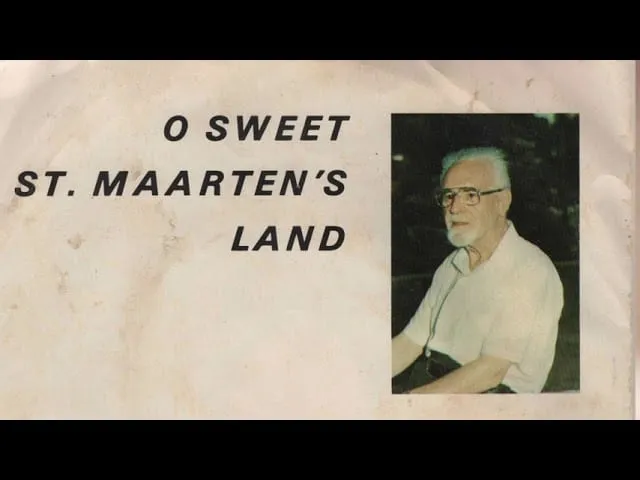
The story of O Sweet Saint Martin Land: the Dutch priest who wrote it in 1958, its two language versions, its real official status, and where you hear it today.
Quick facts
| Song | O Sweet Saint Martin Land (French version: Saint-Martin, si jolie) |
| Written by | Father Gerard Kemps, a Dutch Catholic priest serving on the French side |
| Year | 1958 |
| Language | English, with a separate French version that has different lyrics and a different tune |
| Status | The shared song of the whole island. Customary anthem on both sides, alongside La Marseillaise (French side) and Het Wilhelmus (Dutch side) |
| You’ll hear it | St. Martin Day on November 11, school ceremonies, official events on both sides |
An anthem that shouldn’t exist, and yet
Here’s a riddle for you. Take one island, 34 square miles, split between two European kingdoms since 1648. The north is French. The south is Dutch. The language most people actually speak at the market and on the ferry dock is English.
Now: who writes the song that both sides claim as their own?
A Dutch priest. Working on the French side. Writing in English.
If you wanted to invent a story that captures how Saint Martin works, you could not do better than the true story of O Sweet Saint Martin Land. It’s one of the very few anthems on Earth shared across an international border, and it exists because one man fell head over heels for the island he was sent to serve.
The priest who couldn’t stop looking at the view
Gerard Kemps was born on March 18, 1902 in Venray, a town in the southern Netherlands. In 1954 the Catholic Church appointed him priest for the parish of French Saint-Martin, and he stepped off the boat into a world about as far from Limburg as a Dutchman can get: salt ponds, flamboyant trees, green mornes tumbling down to beaches, pelicans folding themselves into the sea.

_02_2025_01.jpg)
He never really got over it. Kemps later said he wrote the song because he had to sing of “the sweetness, the grace, and the incomparable beauty” of the land unfolding before his eyes. Four years after his arrival, in 1958, he finished it.
He didn’t write a hymn for his parish. He wrote a love song for the whole island, and he wrote it in English, the language French and Dutch St. Martiners actually shared. That single choice is why both sides could adopt it. A French anthem would have stopped at the border in one direction; a Dutch one in the other. English belonged to everybody.
Kemps went on to serve the island for roughly three decades. He died in the Netherlands on December 11, 1990, but by then the song had long since stopped being his. It belonged to the island.
One title, two different songs
Here’s the detail almost every summary gets wrong, so lean in.
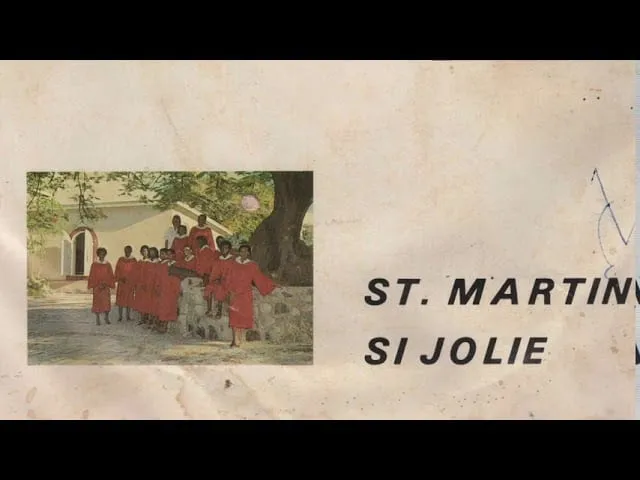
Kemps didn’t translate his song into French. He wrote a second, different song. The French version, Saint-Martin, si jolie (“Saint Martin, so pretty”), has its own lyrics and its own melody. Same author, same island, same devotion, different music.
The English version tours the island’s life: the two nations sharing one small rock, the beaches and harbors, the green chain of mountains, the flamboyant trees blazing red, the cows and goats and famously stubborn donkeys along the roads, and finally Columbus, the Southern Cross overhead, and a prayer for God to protect the coast.
The French version reaches for different images: the island as a pearl in the sea, the golden beaches, Pic Paradis crowning the view, and the pelicans, graceful and elegant, hanging in the air before they dive. If you’ve ever watched a pelican fish off Grand Case at sunset, you know exactly the moment Kemps was trying to bottle.


So when someone tells you the anthem is “in English and French,” you can now be the person at the beach bar who says, “actually, it’s two songs.” You’re welcome. Better yet, don’t take our word for it. Listen to the French version here, then compare it with the English recording at the top of the page. Different melodies, same love letter.
Where to find the full lyrics
You may notice we haven’t printed the words themselves, and that’s deliberate. Father Kemps died in 1990, which means his song is still protected by copyright, and we hold ourselves to publishing the island’s cultural works with permission, not just because everyone else copies them. We’ve reached out to the parish Father Kemps served to ask for its blessing, and the moment we have it, the full lyrics of both versions will live right here.
In the meantime, you can read the opening verse and chorus on the Kemps memorial marker in Marigot, see the full version at the museum, and hear every word sung by the man himself in the recording at the top of this page.
So is it actually the national anthem? (The honest answer)
This is where most pages wave their hands. Let’s do it properly, because the real answer is a small civics lesson in how this island works.
Neither side of the island is an independent country, so neither has a “national anthem” in the treaty-and-passport sense.
On the French side, Saint-Martin is a collectivity of France. The official anthem is La Marseillaise, full stop. O Sweet Saint Martin Land is the local anthem, sung with at least as much feeling.
On the Dutch side, Sint Maarten has been a constituent country within the Kingdom of the Netherlands since October 10, 2010. The kingdom’s anthem, Het Wilhelmus, is official. But Sint Maarten treats O Sweet Saint Martin Land as its own anthem: the government has presented it as the Sint Maarten Song, and it’s the one schoolchildren learn and officials stand for.
No law we can find formally enshrines it on either side. It rules by custom, not by statute, which is somehow more impressive. Nobody ordered anyone to love this song. They just do, and have for more than sixty years, on both sides of the friendliest border in the world.
The record: Kemps on vinyl
The song got its definitive recording around 1980, and it’s a lovely piece of island history in its own right. A 7-inch vinyl single, produced in the Netherlands, featuring the Roman Catholic Church Choir of Marigot with two soloists: a singer credited as Hélène, and Father Kemps himself, then in his late seventies, singing the song he’d written more than twenty years earlier.
The record sleeve credits the original recording to Arno Peterson on St. Maarten, with final production at Studio Theelen in Munstergeleen, back in Kemps’ native Limburg. A song written by a Dutchman on a Caribbean island, finished in a studio a bicycle ride from where he was born. There’s a sermon in that somewhere, and Kemps probably gave it.
The recording itself is featured at the top of this page, preserved and shared by Les Fruits de Mer, the island heritage nonprofit behind Amuseum Naturalis. Put it on, close your eyes, and picture the Marigot choir in 1980, with the author himself on the solo.
Honors and a marker in Marigot
The island didn’t wait for Kemps to die to thank him. In 1984, on the occasion of the Dutch Queen’s Birthday, he was knighted in the Order of Orange-Nassau, a rare honor for a parish priest and a measure of what the song had come to mean.
Today you can visit a historical marker in Marigot, erected by the Rotary Club of St. Martin, honoring “a committed person welcomed in our island” who left behind a hymn “dedicated to our beautiful home and a legacy for our dignity.” It reproduces the opening verse and chorus and points visitors to the full version at the museum.
Where you’ll hear it today
Come to the island on November 11 and you won’t have to go looking for the anthem. It will find you. St. Martin Day marks the legendary 1648 partition of the island, and the ceremonies in Marigot and Philipsburg feature flag raisings, speeches, and the anthems of both sides, with O Sweet Saint Martin Land as the emotional centerpiece that belongs to everyone present.
Beyond that, listen for it at school ceremonies, government events, sporting occasions, and any gathering where the island wants to remind itself that it’s one people under two flags. When the chorus starts, stand up. When locals sing “St. Maarten” instead of “Saint Martin,” sing whichever side of the border your feet are on. Both are correct. That’s the whole point of the song.
Things the internet gets wrong about this anthem
Because we checked, so you don’t have to:
“The melody comes from a Spanish folk song called Adiós, Granada.” No credible source supports this. It appears on auto-generated travel pages that also contradict themselves about basic dates. Every documented source credits both words and music to Kemps.
“It was adopted in 1985” / “adopted in 2011.” No formal act of adoption has been found for either date or any other. The song’s status is customary on both sides, alongside the official French and Dutch anthems.
“The French version is a translation.” It’s a separate song with different lyrics and a different tune, also by Kemps.
“Kemps was a local musician.” He was a Dutch Catholic priest from Venray who served the French-side parish for about thirty years. The island made him its own, which is a better story anyway.
Frequently asked questions
What is the national anthem of St. Maarten?
O Sweet Saint Martin Land, written in 1958 by Father Gerard Kemps, serves as the anthem of both Dutch Sint Maarten and French Saint-Martin. Formally, La Marseillaise is official on the French side and Het Wilhelmus on the Dutch side, with the island song holding customary anthem status island-wide.
Who wrote O Sweet Saint Martin Land?
Father Gerard Kemps, a Dutch Catholic priest born in Venray in 1902, who was appointed to the parish of French Saint-Martin in 1954 and wrote the song four years later. He also wrote a separate French version, Saint-Martin si jolie, with different lyrics and a different melody.
Why is the anthem in English if the island is French and Dutch?
English has long been the shared everyday language of St. Martiners on both sides. Writing in English let one song belong to the whole island.
When is the anthem sung?
Most prominently on St. Martin Day, November 11, during the unity ceremonies, and at school, government, and community events throughout the year on both sides.
Sources
- Historical marker, “Father Gerard Kemps,” Rotary Club of St. Martin, Marigot (transcribed at hmdb.org)
- Government of Sint Maarten, “Sint Maarten Song” (archived page, 2013)
- Les Fruits de Mer, Sound of St. Martin archive: “O Sweet Saint Maarten’s Land” (choir recording, c. 1980) and “St Martin, Si Jolie”
- Record sleeve credits, 7-inch single (Rev. G. Kemps with the R.C. Choir of Marigot; Studio Theelen)
- nationalanthems.info entries for St. Martin and Sint Maarten
- CIA World Factbook, Saint Martin (anthem status note)
- Christophe Hénocq, Heritage magazine no. 2, 2009 (to pull and verify; likely the best primary-adjacent source in this list)