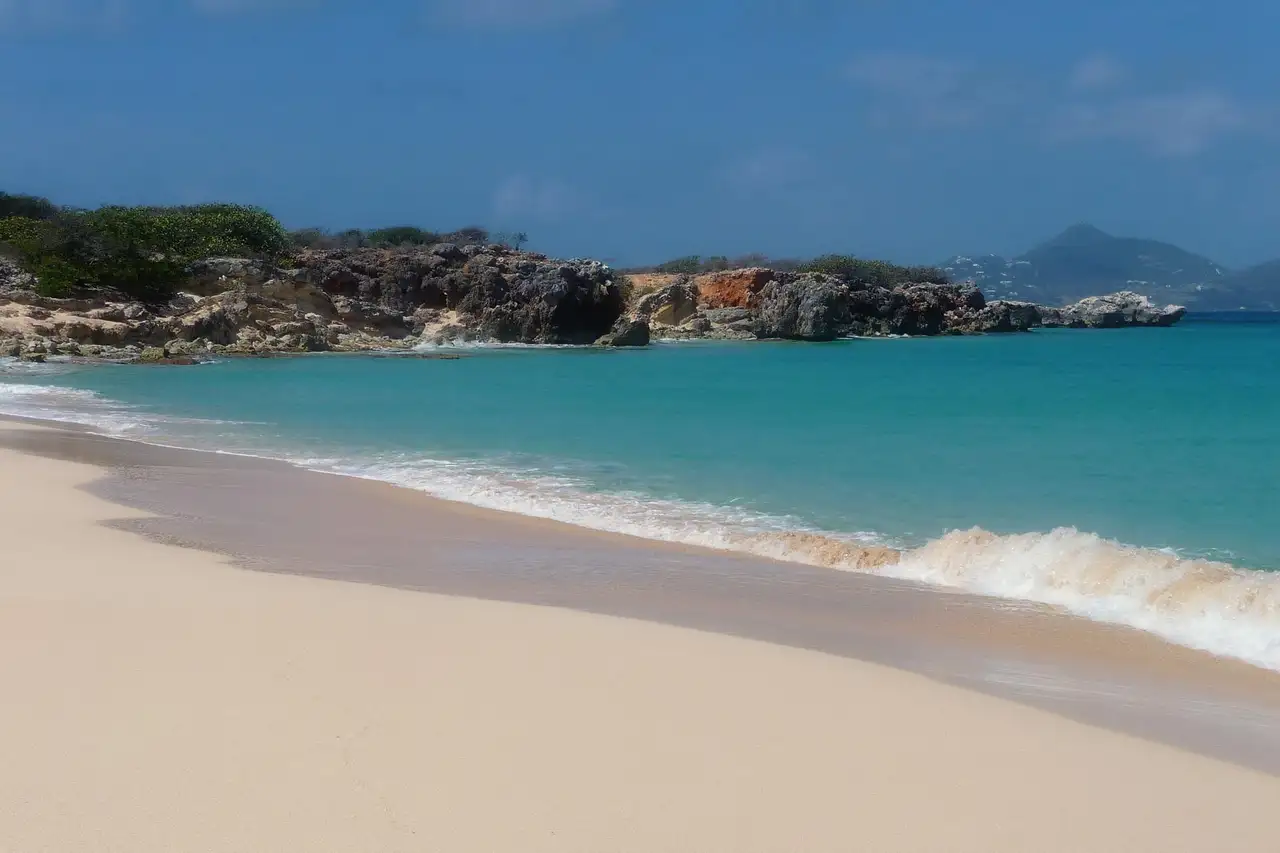
White and fine, on the sheltered Baie Blanche side. At your departure marina only. Anse Marcel, Cul-de-Sac and Oyster Pond all have parking. There is nothing on the island. Reachable by boat only. Fee: No landing fee. Your cost is the boat.
Parking
There is no parking here, because there is no road and no island access except by boat. You park at whichever marina your operator uses. There is also no dock and no jetty: boarding and landing happen directly on the sand from the boat, so you get wet, and anyone who cannot step off a boat into shallow water and walk on sand cannot land.
Water
Calm
Shorebreak
Calm
Snorkeling
Excellent
Shade
No shade
Chairs
No chair rental
Food on site
Nothing on site
Restrooms
None
Facilities
No chairs and umbrellas, restrooms, snacks and drinks, showers, natural shade, or lifeguard
On a ship day
Medium
Crowds
Varies by day
Best time
Midweek in low season, when the moorings are empty. On a busy high-season day with several catamarans anchored, Baie Blanche has a crowd.
Best for
Snorkeling or quiet
Safety
The absence of everything is itself the hazard. No lifeguard, no water, no shade, no shelter, no bins, no phone-in emergency point and nobody on the island. Sunburn and dehydration are the realistic emergencies here. Rescue means whatever boat you came on, so confirm your pickup time and stick to it. Mosquitoes are specifically flagged by the tourist office, so bring repellent. There is scattered aircraft and structural debris inland, some of it metal, so wear closed shoes off the sand. There is a wreck off the southern point of the bay, and boats are told to give that point a wide berth. Do not try to swim the channel between Tintamarre and St. Martin: it carries real current and boat traffic. The exposed north and east sides are a different island entirely, with cliffs, swell and no landing.
The story
Tintamarre is an uninhabited nature reserve island about three kilometres off the northeast coast, and the important thing about it is what is not there. No operator, no concession, no restaurant, no drinking water, no dock. Every single thing on the island the day you visit came off a boat and leaves on a boat. That is the practical difference between Tintamarre and Pinel, and it is also why the island still works ecologically: it is the only nesting site in the whole reserve for the brown noddy. Pinel, three kilometres away in the same reserve, has restaurants and no longer has nesting seabirds at all.
Checked: August 2026 · Reported
An airline flew out of here, and the wreckage is still on the ground
In the years after the Second World War the aviator Rémy de Haenen leased Tintamarre and ran the Compagnie Aérienne Antillaise from a natural airstrip on the island. His starting fleet included a Rearwin Sportster, a Vought OS2U Kingfisher seaplane and a twin-engine Stinson, and the network reached from Puerto Rico in the west to Martinique in the south, connecting islands that had no air service at all. It later added more Kingfishers, a Stinson Reliant and Sikorsky flying boats. It ended in 1950 after a run of accidents that destroyed the fleet's finances and killed three of its pilots.
The airstrip is still there, and visitors find scattered landing gear and fuselage fragments. The Réserve Naturelle's own site confirms the hulls and motors of aircraft abandoned by pilots and by those engaged in contraband when the airstrip was active.
De Haenen was not a minor figure. He flew the first aircraft into what became Gustaf III Airport on St. Barthélemy in 1945, was involved in developing Saba's airport, served as Mayor of St. Barths from 1962 to 1977, founded the Eden Rock hotel and logged 17,000 flight hours before his death in 2008.
Three details we cannot settle, and will not pick a version of. The airstrip's active dates are given as 1945 to 1950, 1946 to 1950 and 1944 to 1952 by three different sources. The runway length is given as 1,500 feet by one and 500 metres, which is 1,640 feet, by another. And de Haenen's nationality is described as mixed French and Dutch heritage by the best source and as Belgian by another. An aviation historian or the St. Martin archives could close all three.
The surviving trace of the airstrip in March 2012. An airline ran from here in the late 1940s until it folded in 1950.SV Zanshin · Wikimedia Commons · CC BY-SA 3.0
The King of Tintamarre
Before the airline there was a man who owned the whole island. Diederik Christiaan van Romondt, from an Amsterdam-descended Sint Maarten dynasty, moved to Tintamarre around 1907, reportedly to escape taxes, and hired workers from Anguilla and Sint Maarten to build a manor house and a farm. He grew Sea Island cotton and raised cattle and goats. By 1902 the island supported around 150 inhabitants working cotton, livestock, dairy, limestone and coral extraction.
In 1913 the Paris newspaper Le Journal ran a piece calling him Le Roi de Tintamarre, the King of Tintamarre. It brought him admirers and marriage proposals from France, Italy and Germany. He never married. He died in 1948 at his original Sint Maarten estate, Mary's Fancy. Anguillans reportedly still tell stories about the man who wanted a wall built around his island for no reason.
The outline is solid. The details are not: his middle name is given as Christiaan or Christian by two sources and as Johannes by a third, and the sale date and buyer are contested, with the tourist office saying he sold in 1931 and another account saying he sold to a French St. Martin trader who then leased it to de Haenen, with no date attached.
The mud bath, and why the rule is not what people think
Tour boats have long taken visitors to Tintamarre for a mud or clay bath: smear white or grey clay from the seabed and shoreline on your skin, let it dry, rinse in the sea. It is a genuine local tradition and it is still sold.
The Réserve Naturelle's own regulation is explicit: removal of clay, and mooring in North Curve Bay, are forbidden. That is a conservation rule about taking material out of a protected area.
Separately, one travel site reports that French authorities banned the mud baths because the clay is toxic. That is not the same claim, it is single-sourced, and we could not find any official document supporting it.
So the honest version: the reserve prohibits removing clay from Tintamarre, which means the mud bath is not a sanctioned activity, and the area associated with it is also closed to mooring. Operators still offer it. If yours does, that is a choice they are making. The toxicity story is unverified and we are not going to repeat it as fact.
The reserve rules, and the very specific one about music
Tintamarre and the surrounding waters sit inside the Réserve Naturelle Nationale de Saint-Martin, and a 665-hectare area around the island carries Important Bird Area designation protecting hummingbirds, tropicbirds and brown noddies.
The reserve maintains 17 permanent yellow moorings for boats up to 50 feet or 15 tons. Boats under 33 feet may anchor on sand only. Prohibited: fishing, jet skis, taking sand, coral, shells or plants, fires, pets and leaving any waste. Music is tolerated provided it remains audible within a two-metre radius maximum, which is a wonderfully precise piece of French regulation and worth knowing before you fire up a speaker.
Overnight mooring needs prior written authorisation filed at least three days ahead, and Tintamarre is one of only two places in the reserve where it is granted at all. Camping is permitted only in designated areas under the same authorisation, with no pets, your own charcoal and fires only at designated points.
One figure we would not quote: infractions are reported to carry fines of up to €1,500, but that comes from a single secondary source rather than the reserve's own regulations. And one set of numbers to distrust: an aggregator gives Tintamarre's mooring limits as 12 metres depth and 10 tons, which appears to blend Tintamarre's limits with Pinel's. Use the reserve's own figures.
A pair of brown noddies in May 2014. Tintamarre is the only nesting site in the whole reserve for this species, which destroys its own nest if disturbed.Wilson CELINI · Wikimedia Commons · CC BY-SA 3.0
The U-boat story is a legend, and we are labelling it as one
Local tradition holds that German U-boats used Tintamarre as a resupply point during the Second World War, under Vichy French administration, trading gold for food and water. One site states it as fact and claims the docks that served Nazi submarines are visible today to anyone who lands.
Wikipedia handles it more carefully, describing the claims as unverified with no written documentation. The most detailed history of the island we found does not mention it at all.
There are concrete remains on the island. Whether they served submarines is unestablished. It is worth understanding why the story persists: Vichy administration in the French Antilles was real, and Caribbean U-boat activity in 1942 was extensive and documented elsewhere. That makes it plausible, which is not the same as true.
This is a legend, and it goes on the page as a legend.
Ruins associated with the former airstrip, photographed in March 2012. What each building actually did is not documented.SV Zanshin · Wikimedia Commons · CC BY-SA 3.0
Getting there, and what it might cost
Boat only. There is no ferry, no scheduled service and no operator based on the island. You get there on an organised excursion, a charter or your own boat. Departure points in use are Anse Marcel marina, Oyster Pond, Cul-de-Sac and Marigot, and Dutch-side operators run from Simpson Bay and Philipsburg as part of longer day trips. Crossings run roughly 15 to 30 minutes depending where you leave from. Shuttles typically depart between 9 and 10am with afternoon returns around 4:00 to 4:30pm.
On price, we have one source and we do not trust it enough to publish a number as fact. It gives €20 to €35 per adult round trip for a direct shuttle, €45 to €85 for an organised excursion including snorkeling and guiding, and from around €220 a day for a private boat rental requiring a navigation permit. Those figures come from a single undated French page. Treat them as a rough shape and price real operators.
The snorkeling is why most boats stop. Baie Blanche has a shallow sandy bottom close in and coral formations further out, with consistent reports of green and hawksbill turtles, southern stingrays and large schools of sergeant majors. The reserve itself calls out the north point for clear water. The anchorage sits in about seven metres over sand and is secure in easterly winds but described as quite rolly, which is why it is a day anchorage rather than an overnight one.
Pack as though nothing exists there, because nothing does: water, lunch, shade, repellent, closed shoes, a dry bag. If your excursion does not include lunch, you do not eat.
The Atlantic-facing east coast in March 2012. This is why boats land on the sheltered west side and nowhere else.SV Zanshin · Wikimedia Commons · CC BY-SA 3.0
Common questions
Quick fact
How do you get to Tintamarre?
Only by boat, and there is no scheduled ferry. You go on an organised excursion, a private charter or your own vessel, departing from Anse Marcel, Cul-de-Sac, Oyster Pond, Marigot or the Dutch side. Crossings run roughly 15 to 30 minutes depending on where you leave from.
Quick fact
Is there anything on Tintamarre? Restaurants, toilets, water?
No. Nothing. The island is uninhabited and no operator is based on it. There are no restrooms, no showers, no drinking water, no bar, no restaurant, no shade structures and no dock. Everything you eat and drink comes off your boat.
Quick fact
Can you still do the mud bath at Tintamarre?
The Réserve Naturelle's published rule prohibits removing clay from the island, and North Curve Bay is closed to mooring. Operators still offer mud baths. A claim that the clay was banned as toxic circulates online but is single-sourced and unsupported by any official document.
Quick fact
What is the plane wreckage on Tintamarre?
Remains of the Compagnie Aérienne Antillaise, an airline the aviator Rémy de Haenen ran from a natural airstrip here in the late 1940s, connecting islands from Puerto Rico to Martinique. It folded in 1950 after a run of fatal accidents. Landing gear and fuselage pieces are still scattered near the strip.
Quick fact
Is the snorkeling at Tintamarre good?
Yes, and it is the main reason boats stop there. Baie Blanche has a shallow sandy bottom close in and coral further out, with green and hawksbill turtles, southern stingrays and schools of sergeant majors. There is also a shipwreck off the southern point of the bay.
Quick fact
Can you stay overnight on Tintamarre?
Only with prior written authorisation from the Réserve Naturelle, filed at least three days in advance. Tintamarre is one of only two places in the reserve where night mooring is granted, and camping is restricted to designated areas under the same authorisation.
Keep planning
Where this fits
Pinel Island, the nearest beach with a page of its own
Green Cay, the nearest beach with a page of its own
Last checked August 17, 2026. Everything on this page is confidence reported: drawn from credible sources but not independently confirmed by us. Beach conditions change with the weather and the season, and businesses on the sand open and close, so check anything you are building a day around.
Desk research pass, docs/research/research-tintamarre.md, holding the full claim to source table and the confidence flag on every claim
Ships in port, what's on, and island conditions for the week ahead. Every Monday. A couple of minutes to read, unsubscribe anytime.
Something went wrong on our end and we could not add you just now. Please try again in a moment, or emailleslie@thisissxm.comand we will add you by hand.
We will only use your email for island guide updates. Unsubscribe anytime.