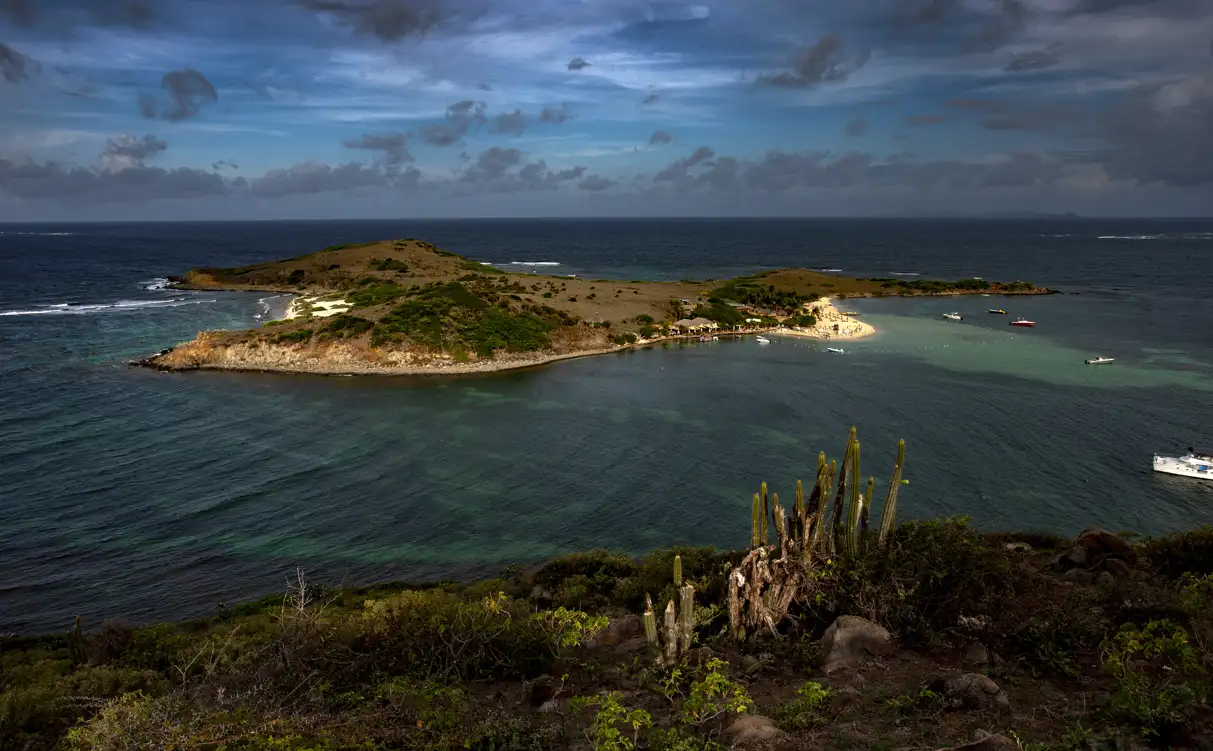
White to pale gold, fine, over a very gradual shallow shelf. Free lot at the Cul-de-Sac ferry dock on the mainland. It fills early, and February 2026 visitors report it filling very quickly. Reachable by boat only. Fee: No landing fee. The ferry is €10 or $12 round trip, cash to the captain.
Parking
Free lot. The parking is on the mainland at the Cul-de-Sac dock, not on the island. It is free and it fills early, and February 2026 visitors describe it filling very quickly. Heavy cruise days empty it sooner, because Pinel is a shore excursion and taxi drivers push it. Aim to be there by 9:30 in high season.
Water
Calm
Shorebreak
Calm
Snorkeling
Good
Shade
Some natural shade
Chairs
Chairs available
Food on site
Restaurants
Restrooms
Customers only
Facilities
Chairs and umbrellas, restrooms, snacks and drinks, showers, natural shade. No lifeguard
On a ship day
Medium
Crowds
Busy
Best time
The 9:30 boat. It buys you an hour of near-empty sand before the 11am to 3pm crush.
Best for
Families, snorkeling, or food and drink
Safety
No lifeguard. The main beach is shallow and gradual and about as benign as swimming gets here, but the Atlantic-facing beaches on the far side are rocky, exposed and a different proposition. Rescue is boat-only: the nearest hospital is a crossing plus a 25 to 30 minute drive to Marigot. The island has no running water supply, so bring your own. Natural shade is limited and claimed early. One February 2026 visitor reported no life jackets on a crowded shuttle boat.
The story
Pinel is a five-minute boat ride and a completely different island. The main beach faces back toward St. Martin, so it is sheltered, shallow and gradual, which makes it one of the best places on either side for small children and nervous swimmers. It also sits inside the Réserve Naturelle Nationale de Saint-Martin, and the reserve's own fact sheet does not sell it: it calls Pinel a perfect little place that is often overrun with crowds. Both halves of that are true, and which one you get depends almost entirely on which boat you take.
Checked: August 2026 · Reported
The crossing, and what it costs
You drive or take a taxi to the ferry dock at Cul-de-Sac on the French northeast coast, then take the shuttle boat. The crossing is about five minutes across roughly 300 metres of sheltered water, with boats every 30 minutes or sooner once one fills. It is €10 or $12 per person round trip, cash to the captain, no reservation. You can also kayak or paddleboard across from Cul-de-Sac bay, or arrive on your own boat.
Driving, it is 35 to 50 minutes from Philipsburg, 25 to 30 from Marigot, about 10 from Orient Bay. There is no practical bus. A taxi runs around NAF 90 or $50 an hour as a reference rate, and taxis are not reliably waiting at the dock when you come back, so arrange your pickup before you cross.
On the last boat back, sources do not agree: 4:30pm and 5:00pm both appear for high season, 4:00pm for low. Be at the dock by 4:15 and confirm the time with your captain on the way over. Nobody stays on the island overnight, and night access is prohibited.
Getting on and off is a step from a low jetty into a small open boat and a step out onto sand at the other end. There is no ramp and no accessible boarding. Once you are there, the beach itself is flat with a very gradual entry, which is genuinely good.
The shallow shelf off the main beach, photographed in October 2011. The beach furniture has changed since, the water has not.Clavius66 · Wikimedia Commons · CC BY-SA 3.0
Can you bring your own food and drink? The honest answer
This is the most-asked question about Pinel and nobody publishes a formal policy. Not the reserve, not the restaurants, not the ferry. So here is what is actually established.
The Réserve Naturelle's own fact sheet points visitors to the grocery and pharmacy in Cul-de-Sac village to get supplies before crossing, which is an official source assuming you provision yourself. The reserve's camping rules require you to bring your own charcoal, because collecting anything inside the reserve is prohibited, which assumes the same thing. Nothing in the reserve regulations prohibits bringing food or drink. What is prohibited is leaving anything behind.
The real constraint is commercial rather than legal. The sand in front of Karibuni and Yellow Beach is their service area and their chairs and umbrellas are rented, not free. The workable version: bring a cooler and eat on the public sand, do not expect to sit in a restaurant's chairs while you do it, and carry every scrap back to the boat. That is convention, not a posted rule, and we would rather tell you that than invent a policy.
The island closes for six weeks a year and almost nobody says so
Karibuni closes annually from 23 August and reopens in mid-October. That is peak hurricane season and deep low season, and it is a genuine trap: turn up at Cul-de-Sac in early September and the island's main restaurant is shut.
What happens to the ferry during that window is not something any source states. An October 2025 visitor reported a ferry operator saying the restaurant was not going to stay open for six people, which suggests low-season service is thin and conditional. If you are going between late August and mid-October, call ahead before you drive out there.
The rest of the year, both restaurants are trading and that is well evidenced. Karibuni sits on the left of the main beach as you land, run by Erick and Marion for around 30 years, with lobster from an on-site tank, open seven days in high season from 9:30am to 5:00pm on the ferry schedule, and a Green Key sustainable tourism label awarded in 2026. Reservations are recommended through its site up to a day ahead. Yellow Beach is the first thing you see on landing, directly in front of the ferry dock, family-run, with chairs and tables set in the water.
Chairs: Karibuni publishes €35 a day for two deckchairs and a parasol, and a March 2026 visitor reported prices reaching $40 for the day. Karibuni recommends reserving ahead and warns that chairs are given away after a 15-minute grace period. Prices here go stale fast, so treat those as of 2026 and confirm.
The bar and pier scene in March 2010, seven years before Irma. Both restaurants were flattened in September 2017 and rebuilt, so what stands today does not match this frame.Mark Mitchell (Sirsnapsalot) · Flickr · CC BY 2.0
It is a national nature reserve, and the rules are enforceable
Pinel sits inside the Réserve Naturelle Nationale de Saint-Martin and its marine park. Jet skis and fishing are prohibited. Boats under 33 feet may anchor on sandy bottoms only, and 15 permanent yellow moorings take boats up to 40 feet or 10 tons, specifically to keep anchors off the seagrass. Overnight mooring is not permitted.
Camping is allowed only in designated areas on Pinel and Tintamarre, with an authorisation form filed at least three days in advance, no pets, charcoal brought in, and fires only at designated fire points. Nothing is collected: no coral, no shells, no sand, no plants. Dogs are not permitted on the ferries and pets must stay aboard boats inside the reserve, so do not bring a dog.
One figure we could not stand behind: reserve infractions are reported to carry fines of up to €1,500, but that comes from a single secondary source and not from the reserve's own regulations. Treat it as a signal that the rules have teeth rather than as a quoted number.
Reef-safe mineral sunscreen is recommended, and it is the easiest thing on this list to get right before you leave the house.
The snorkeling, and the two things people confuse
There are two separate offerings here and travel content routinely muddles them.
The first is the marked underwater trail, the sentier sous-marin, a signposted snorkel route inside the reserve. The reserve describes it as an ecosnorkeling path with a professional guide, who is also a marine biologist, renting equipment and accompanying visitors, no air tanks. The trail won the 2011 IFRECOR award for originality and was funded jointly by the reserve, the Conservatoire du Littoral and FEDER. One guide puts its start to the right of the jetty, along the coral heads, with parrotfish, sergeant majors, blue tangs and the occasional green turtle. We could not confirm the exact start point, and the reserve page describing the guided service is undated and may predate Irma, so check whether it is running before you count on it.
The second is the reef on the island's far side, which August 2025 visitors found better but described as needing intermediate to experienced snorkelers. March 2026 visitors found big waves and shallow water that stopped them snorkelling at most spots. Wind is the deciding variable, and the far side is the half that takes it.
Swimmers should stay inside the beach area. The channel between Pinel and the mainland carries the shuttle traffic, and boaters are directed through the passage between Green Cay and Pinel because the approach is otherwise tricky.
The trail up the hill, and why the birds left
Most day-trippers never leave the main beach. The reserve maintains a 1.5 km coastal-vegetation trail across the island linking three of its beaches, with information panels and two orientation tables that name the surrounding islets, plants and birds. Routard gives the circuit as about 30 minutes; another guide describes a 20-minute climb to a 38 m summit with views over Orient Bay, Tintamarre, Anguilla and Saint Barthélemy. We could not reconcile the timings, but the trail is real and reserve-maintained, and it is also how you reach the quieter beaches on the far side.
There is also a documented pre-Columbian archaeological site on Pinel's southwestern beach, found in 2000, with ceramic, lithic and shell artefacts.
And here is the part worth sitting with. The reserve notes that seabirds pass Pinel but no longer nest there, because of human presence. The island now supports goats, lizards, iguanas and hermit crabs. Three kilometres away, Tintamarre is the only nesting site in the whole reserve for the brown noddy, and the reserve protects the bird specifically because it destroys its own nest if disturbed. Two islets, one reserve, opposite outcomes, and the difference is how many people step ashore.
A red-footed tortoise on Pinel in December 2025. The species is introduced in the Lesser Antilles rather than native, which is worth knowing before anyone calls it local wildlife.Jsw618 · Wikimedia Commons · CC BY 4.0
Common questions
Quick fact
How do you get to Pinel Island?
Take the shuttle boat from the dock at Cul-de-Sac on the French northeast coast. The crossing is about five minutes, boats run roughly every 30 minutes from around 9:30am, and it is €10 or $12 per person round trip, cash to the captain, no reservation needed.
Quick fact
Are the restaurants on Pinel Island still open?
Yes. Karibuni and Yellow Beach were both operating through 2026, confirmed by dated visitor reports from January to June. One catch: Karibuni closes every year from 23 August and reopens in mid-October, and no source says what the ferry does during that window.
Quick fact
Can you bring your own food and drink to Pinel Island?
Nothing in the reserve regulations prohibits it, and the reserve itself points visitors to the grocery in Cul-de-Sac for supplies. You carry out all waste, and you cannot use a restaurant's rented chairs without paying. No operator publishes a formal policy, so this is convention rather than a posted rule.
Quick fact
How much are beach chairs on Pinel Island?
Karibuni publishes €35 a day for two deckchairs and a parasol and recommends reserving ahead. A March 2026 visitor reported $40 for the day. Chairs are released after a 15-minute grace period if you have not turned up. Prices move, so confirm before you go.
Quick fact
Is Pinel Island good for young children?
It is one of the best on either side. The main beach faces back toward St. Martin, sheltered by the islet itself, with a gradual shallow shelf and essentially no shorebreak. There is no lifeguard. The far side of the island is rocky and exposed and is a different beach entirely.
Quick fact
What time is the last boat back from Pinel?
Sources give 4:30pm or 5:00pm in high season and 4:00pm in low season. Be at the dock by 4:15pm and confirm the time with your captain on the way over. Night access is prohibited and nobody stays on the island overnight.
Keep planning
Where this fits
Tintamarre, the nearest beach with a page of its own
Green Cay, the nearest beach with a page of its own
Cul-de-Sac, the nearest beach with a page of its own
Last checked August 17, 2026. Everything on this page is confidence reported: drawn from credible sources but not independently confirmed by us. Beach conditions change with the weather and the season, and businesses on the sand open and close, so check anything you are building a day around.
Desk research pass, docs/research/research-pinel-island.md, holding the full claim to source table and the confidence flag on every claim
Ships in port, what's on, and island conditions for the week ahead. Every Monday. A couple of minutes to read, unsubscribe anytime.
Something went wrong on our end and we could not add you just now. Please try again in a moment, or emailleslie@thisissxm.comand we will add you by hand.
We will only use your email for island guide updates. Unsubscribe anytime.