Pale coral sand on the western beach, a sand spit of about 95 metres. None. This is an islet reached by boat from Orient Bay, so your parking question is Orient Bay's. Reachable by boat only. Fee: No landing fee. Charter or watersports costs apply.
Parking
Not applicable: this is a boat-only islet a short distance off Orient Bay. What we could not establish is genuinely important and we would rather say so: no source gives the distance from the Orient Bay shoreline, no named operator, charter or watersports desk offering a Green Cay trip was confirmed, and it is unclear whether commercial boats may drop and collect passengers at the western beach given that commercial activity on the islet is prohibited. Whether paddling out is sensible is also unestablished, and the reserve itself flags the active water-sports traffic in Orient Bay between the shore and the islet.
Water
Calm
Snorkeling
Excellent
Shade
No shade
Chairs
No chair rental
Food on site
Nothing on site
Restrooms
None
Facilities
No chairs and umbrellas, restrooms, snacks and drinks, showers, natural shade, or lifeguard
On a ship day
Low
Crowds
Quiet
Best time
A flat, calm day. The mooring offers limited protection and becomes untenable in a northern swell.
Best for
Snorkeling or quiet
Safety
There is no help here of any kind: no facilities, no water, no shade, no lifeguard, and you are relying on the boat you arrived on. Active water-sports traffic crosses Orient Bay between the shore and the islet, which the reserve itself flags. The islet's eastern side is exposed open Atlantic over limestone and rock and is not a place to swim. Nothing is documented about shorebreak or currents on the western landing beach, so assume real water movement around an offshore islet with reef on two sides. There is also a legal hazard worth naming: walking beyond the permitted area is a reserve infraction, not just bad manners.
The story
Green Cay, or Caye Verte, is a 13-acre limestone islet a short way off Orient Bay, and the rules governing it are unusually precise. You may land on one beach and nowhere else. You may walk on the dune and no further. There are no restaurants and there cannot be any, because commercial activity on the islet is prohibited outright. The reason for all of it is birds: this is a nesting site for white-tailed tropicbirds and white-cheeked pintails, and every restriction follows from that one fact.
Checked: August 2026 · Reported
You can land, but only on one beach, and you cannot walk the island
This is the question people search, and the answer is specific rather than yes or no.
The Réserve Naturelle Nationale de Saint-Martin states that landing is authorised only on the western beach, which lies outside the reserve boundary, and that the rest of the site is closed to entry except for water-based activities. Walking is restricted to the sand dune. Motor vehicles, dogs and fires are prohibited. Under Prefectural Order 2020-142, commercial activities on the islet are banned outright.
That last rule explains the structural difference between Green Cay and Pinel, three kilometres up the coast in the same reserve. Pinel has beach restaurants and a shuttle. Green Cay has neither and cannot.
The design of the rule is worth understanding, because it is elegant. The boundary was drawn to leave one small beach outside the reserve so that people can step ashore, while the interior, the rocky middle and the exposed eastern side stay closed. You are being given a doorstep, not a house.
The islet is about 13 acres, roughly twenty times smaller than Tintamarre, with a limestone coral base, a north-south orientation and three distinct parts: the western beach, a rocky middle, and an Atlantic-facing eastern side. The beach itself is a sand spit of about 95 metres.
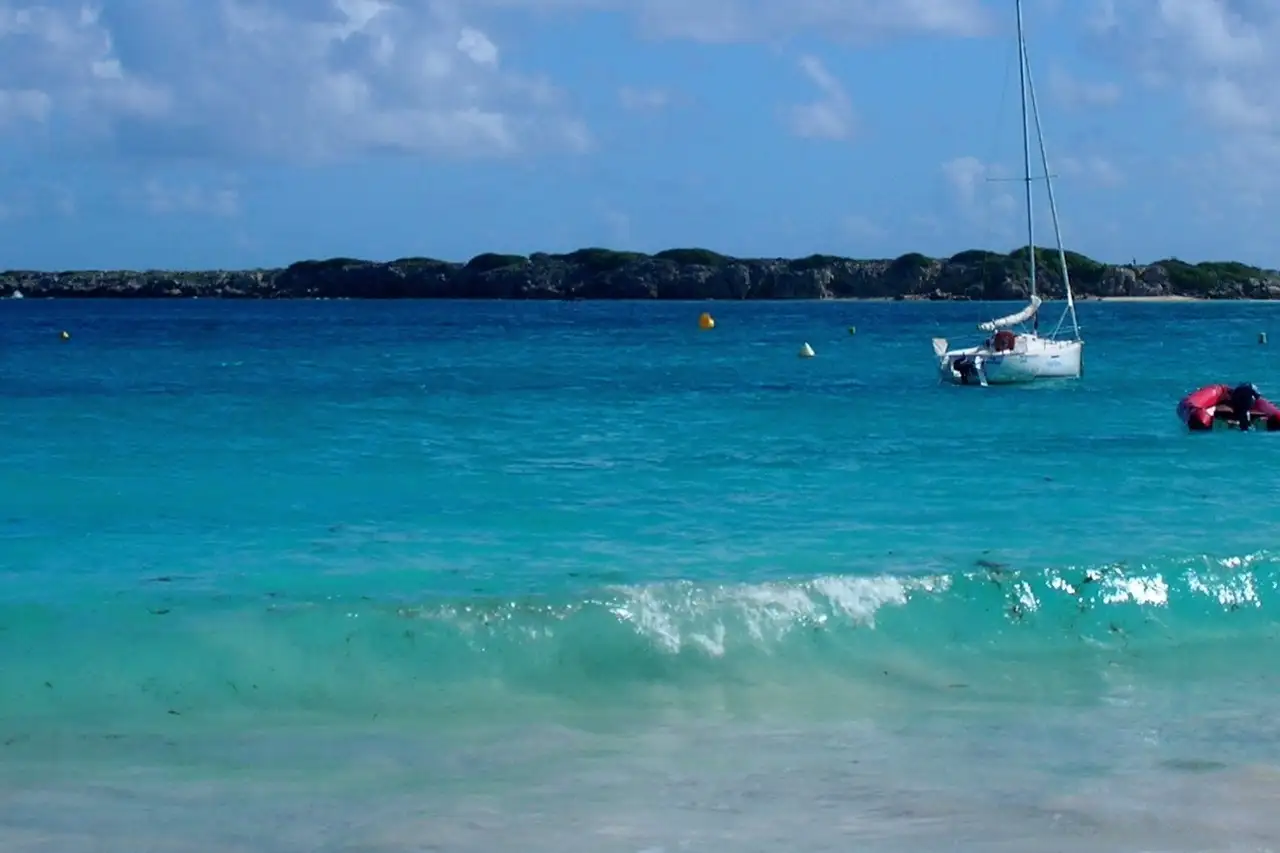
Caye Verte in October 2012. The western beach, the one you may land on, faces back toward the camera.Clavius66 · Wikimedia Commons · CC BY-SA 3.0
The birds are the reason for the rules
Green Cay is a nesting site for white-tailed tropicbirds and white-cheeked pintails, and the reserve's deputy director is quoted explaining that mooring is restricted in most areas to protect the birds that come there and nest.
That is the causal chain a visitor almost never gets. A small limestone islet with no predators and no people is a seabird refuge, and every restriction on the list, the mooring limits, the no-landing zones, the dune-only walking, the dog ban, follows from that rather than from generic conservation instinct.
It also explains why the mooring capacity is so small. The reserve's own site gives a single buoy for vessels up to 10.5 metres and 8 tons; the Collectivité tourist office says two buoys for boats under 35 feet. We could not resolve which is current, and either way the practical point holds: the islet's carrying capacity is one or two boats at a time, deliberately. Overnight mooring is prohibited. Anchoring in reef or seagrass is forbidden throughout the reserve, so anchoring here means sandy bottom only, and only when no buoy is free.
One unusual permission: commercial night diving is allowed at Caye Verte with the reserve management's permission, one of only three sites in the reserve where it is permitted at all.
The snorkeling, and what a fishing ban does
This is the reason to come, and the reserve's own explanation of why it works is unusually direct. It calls the site just east of Green Cay superb and attributes the density of life to the fishing ban: placed under the protection of the nature reserve, fishing is forbidden, which allows fauna and flora to develop freely.
The reef runs along the islet's northern and southern edges and is accessible by both diving and snorkeling, and you snorkel from the mooring buoys. The surrounding seagrass beds are important turtle feeding grounds.
So Green Cay is a compact, legible before-and-after argument sitting a few hundred metres off the island's busiest beach: same water, different rules, visibly different fish. That is a better case for protection than any list of species.
The islet's own reef, on those northern and southern edges, is also what shelters the calm water of Orient Bay behind it. The eastern side is a completely different proposition, exposed to the open Atlantic and taking the trade winds directly.
One thing to keep straight: turtles feed in the seagrass around the islet. Whether they nest on the islet itself is claimed by travel sites and not confirmed by any reserve material we retrieved, which named seabird nesting and turtle feeding habitat only.
The same islet in October 2014, from the same shoreline two years later. The reef along its northern and southern edges is what shelters the water behind it.alljengi (Flickr user 27718315@N02) · Wikimedia Commons · CC BY-SA 2.0
A worked example of why not to trust travel-site coordinates
One villa-marketing page publishes a Green Cay entry giving coordinates that land near Cole Bay on the Dutch side, most of the way across the island from the actual islet. It gives an area of 2.5 acres against the 13 acres the Collectivité reports, describes dense forested areas and resident snakes, and advertises guided eco-tours landing on the island, which would be a prefectural-order infraction.
Every element of that is wrong, and the page is written confidently.
We are keeping it here as a teaching example rather than out of spite. This is the recycled-and-generated content problem across St. Maarten and St. Martin beach coverage in one page, and it is checkable in about ninety seconds against the reserve's own material.
It is also why this record's own coordinates field is empty. There is a gazetteer figure for the islet, and it is not going on the page until somebody has confirmed it.
Common questions
Quick fact
Can you go to Green Cay in St. Martin?
Yes, by boat, and you can land on the western beach only. That beach sits just outside the reserve boundary. The rest of the islet is closed to entry, walking is restricted to the sand dune, and dogs, fires and vehicles are banned.
Quick fact
How do you get to Green Cay?
By private boat, charter or a watersports operator from Orient Bay. There is no scheduled ferry equivalent to the Pinel shuttle, because commercial operations on the islet are prohibited under the reserve's prefectural order. Mooring is limited to one or two buoys for small vessels, and overnight mooring is prohibited.
Quick fact
Is the snorkeling at Green Cay good?
Yes. The reserve describes the site just east of the islet as superb and credits the fishing ban for it. The reef runs along the islet's northern and southern edges and the surrounding seagrass beds are turtle feeding grounds. You snorkel from the mooring buoys.
Quick fact
Can you anchor at Green Cay?
Only on sandy bottom, and only when no mooring buoy is free. Anchoring in reef or seagrass zones is forbidden throughout the reserve, and overnight mooring at Green Cay is prohibited. The anchorage becomes untenable in a northern swell.
Quick fact
How big is Green Cay?
About 13 acres, roughly twenty times smaller than Tintamarre, with a limestone coral base and a beach of about 95 metres on the western side. The islet has three distinct parts: the western beach, a rocky middle and an exposed Atlantic-facing eastern side.
Last checked August 17, 2026. Everything on this page is confidence reported: drawn from credible sources but not independently confirmed by us. Beach conditions change with the weather and the season, and businesses on the sand open and close, so check anything you are building a day around.
Desk research pass, docs/research/research-green-cay.md, holding the full claim to source table and the confidence flag on every claim
Ships in port, what's on, and island conditions for the week ahead. Every Monday. A couple of minutes to read, unsubscribe anytime.
Something went wrong on our end and we could not add you just now. Please try again in a moment, or emailleslie@thisissxm.comand we will add you by hand.
We will only use your email for island guide updates. Unsubscribe anytime.


.JPG)
_(cropped_to_Caye_Verte).jpg)